Respond to Google reviews without breaking GDPR
GDPR-safe Google review replies: what not to publish, legal basics, AEPD case study, and a checklist for clinics and local businesses.

Relvio Team
- Legal
- Google Business
- Online Reputation

Responding to reviews under GDPR means posting a Google Business Profile reply (or any public channel) without leaking unnecessary personal data, without confirming sensitive facts the author did not share, and without using the reply to rebut a customer with internal clinical or billing records.
The answer is indexed like the review. What you write can be personal data processing under the EU GDPR. In Spain, the LOPDGDD adds national rules, including health data.
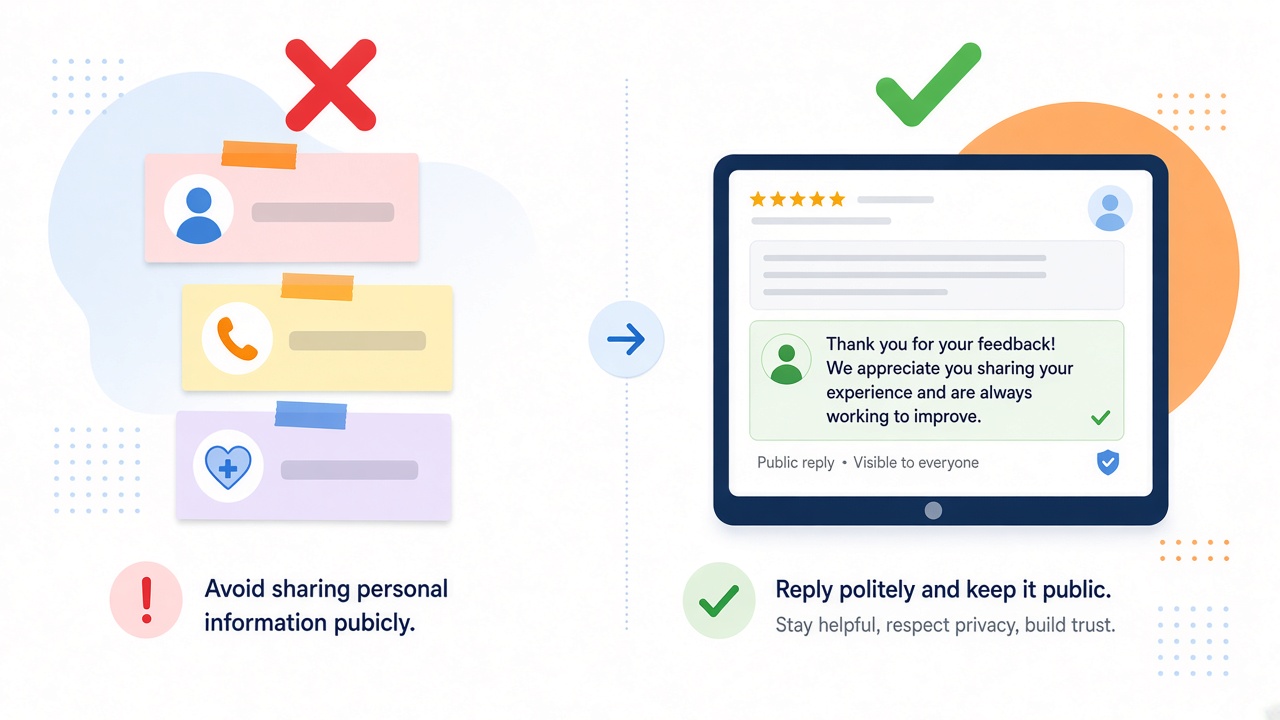
When you respond to Google reviews, use only what you need: thank or apologise, mirror facts the customer already published, and offer private contact. Do not paste ID numbers, phone numbers, medical history, or invoice details. For tone and timing across review types, start with how to respond to Google reviews; this piece covers privacy and enforcement risk.
Notice: this article is informational, not legal advice.
Why does GDPR matter when you reply?
Whoever manages the profile is typically controller for data in the published reply, not only for CRM records. GDPR requires lawful, minimal processing (Article 5.1.c) and integrity and confidentiality (Article 5.1.f).
Healthcare triggers Article 9 (special categories). Even if the customer mentions treatment in the review, your reply is not exempt: adding file details is usually unlawful and disproportionate.
BrightLocal’s Local Consumer Review Survey (2025) reports 89% of consumers are more likely to use a business that responds to all reviews. The balance is speed without turning the reply into an exposed dossier.
What happened in AEPD case EXP202206316?
Spain’s data protection authority (AEPD) fined an ophthalmology institute €7,000 in a decision linked to file EXP202206316 (26 October 2023, reference PS/2023/0016 in the AEPD resolutions repository). Proven facts in that decision include publishing the complainant’s name, ID, phone, health data, and other details in the response to a negative review.
The fine split is €5,000 for GDPR Article 5.1.f) and €2,000 for Article 32. It is one case, but the lesson travels: “winning” the argument in public can cost far more than a bad rating.
| Fact | Takeaway for your business |
|---|---|
| Reply contained ID and phone | Never use customer identifiers in public text |
| Health data on Google | Do not confirm diagnoses or treatments |
| Justification from internal files | Use private channels and DPO workflows, not Maps |
| €7,000 total fine (2023) | Risk is real even when the review feels unfair |
What can I say in public, and what should I avoid?
Split what is already in the review from what only you know from contract or clinical records.
| Scenario | Usually acceptable | Avoid |
|---|---|---|
| Restaurant wait complaint | “We note the wait you mention on Saturday” | “Your 9:15 p.m. booking under phone number…” |
| Generic clinic criticism | “We are sorry the visit fell short; contact us at…” | “As your orthodontics patient since 2022…” |
| Fake review | Report to Google; minimal public reply | Publishing CRM proof with personal data |
| Positive review | Echo the praise they wrote | Adding staff surnames they did not name |
For real complaints, pair negative Google reviews: how to respond with this table before you hit Publish.
Which GDPR articles show up most often?
Public review replies often trigger several GDPR articles on EUR-Lex:
| Article | Practical meaning when you reply |
|---|---|
| 5.1.c (minimisation) | Do not publish more data than strictly needed to answer |
| 5.1.f (confidentiality) | Protect information from unauthorised disclosure, including on Google |
| 9 (special categories) | Health data needs a strong legal basis; public replies rarely qualify |
| 32 (security) | Internal procedures, training, and human review before publishing |
| 83 (penalties) | Serious breaches can reach up to €20 million or 4% of global annual turnover (statutory caps in the law, not a forecast for your case) |
Supervisory authorities apply those caps with proportionality. The ophthalmology file shows one Maps argument can trigger multiple articles at once.
How does this relate to Spain’s Law 10/2025 and fake reviews?
Law 10/2025 and online reviews strengthens consumer transparency and reply rights; GDPR caps what you may say when you reply. You can have a right to respond on the channel and still not be allowed to process certain data in that response.
If the review is fake, follow how to remove fake Google reviews. Send evidence through Google’s private reporting flows; do not upload CRM screenshots with personal data in the public reply.
Five steps to reply without breaching GDPR
- Read the review and flag sensitive topics (health, minors, staff).
- Draft using only public facts or generic wording.
- Check the draft: “Do I identify someone or reveal health/billing?” If yes, cut it.
- Offer the profile email or phone for follow-up off Google.
- Log the case internally without mirroring public text into clinical records.
In clinics, align step 3 with Google reviews for clinics and healthcare.
For restaurants or retail, the same minimisation rule applies: you may reference the dish or product the customer named, but not loyalty card numbers, refund amounts tied to an individual, or staff HR notes. If a reviewer mentions a disability or pregnancy, do not expand with medical detail in your reply.
Google’s policy on review content forbids sharing personal information in reviews; mirror that caution in your answers. A polite public reply plus a documented private follow-up usually satisfies both reputation goals and privacy law better than a data-heavy rebuttal.
Can AI help without adding risk?
Yes, with manual publishing and clear rules. Relvio, Spanish Google review management software with AI, can suggest empathetic drafts with private contact; you must block prompts like “include chart number” or “confirm they are a patient”.
Train responders: one owner with a GDPR checklist in micro businesses; written protocol in chains. GDPR Article 32 expects appropriate technical and organisational measures; a signed checklist counts as organisational.
How do I apply this in my business?
- One-page policy on forbidden data in public replies and who approves exceptions.
- Safe template for negatives: thank, apologise, contact; no confirming patient status in healthcare.
- Private channel on the profile (privacy or front-desk email), not the owner’s personal mobile.
- Annual training if you process health data (Article 9 GDPR and LOPDGDD).
- Audit old replies and edit or remove answers that expose data (Google lets you edit responses).
You may also like: how to respond to Google reviews by type, automate Google review response drafts with AI (always with human review), and Relvio pricing if you centralise multiple locations.
Frequently asked questions
Manage your Google reviews with Relvio
Respond to every review in seconds with AI, monitor all your locations, and improve your online reputation from a single dashboard.
Start for freeNo credit card required. Ready in 5 minutes.